

Stiffness Vs. Toughness Pt. 1
Toughness: the forgotten trait of connective tissue.

Current tendon thoughts and approaches would have clinicians believe that tendon stiffness equals a healthier tendon. I think that’s only half of the story. The recent conversation about tendon rehab has revolved around this idea that increasing tendon stiffness, whether by increasing cross-sectional area, or by increasing the density of collagen, should be the main goal of tendon rehab. This is further encouraged with heavy load protocols, emphasis on overcoming isometrics, and the integration and rise in popularity of using force decks and dynamometers in the rehab setting.
On the surface this idea makes sense. If I make something bigger and thicker it can withstand more force, this is partially true, but it starts to lose sight of the purpose and utility of a tendon. There needs to be a shift from valuing just tendon stiffness, and understanding and chasing tendon toughness.
Tendon toughness isn’t a term I see very often when reading about connective tissue. It’s never talked about in literature. Stiffness, tissue density, CSA are mainly talked about in research. Toughness even sounds like a bit of a jargon term, but it is a very real and objective term, perfect for us to ground our thought process and chase as an adaptation. So what’s the difference between the two? In order to define our terms we need to take a look at the stress-strain curve.
If we were to get an engineering degree, we’d spend an entire semester on learning about material sciences. In this class we’d likely be looking and thinking about the stress-strain curve everyday. What this curve describes is how any material behaves/deforms/stretches when load or force is applied to it. It’s extremely useful in applying a framework for understanding tendons, assessing them, and training them. I don’t think this curve gets the credit it deserves, and the more I understand it, the more I’m shocked at how little we’re taught about it in both exercise science and sports medicine curriculum.
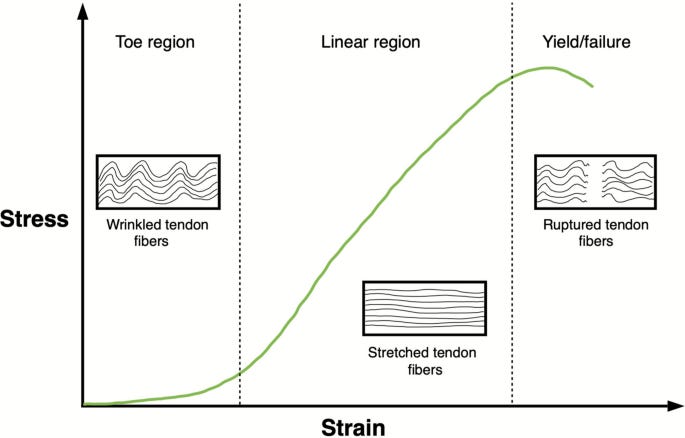
Above is a typical curve for tendon, pretty straight forward. Stress on the y-axis, this is how much load or force is applied to the tissue. Strain on the x-axis, this is a measure of the amount of stretch of the tendon under load. The graph just shows how much stretch occurs at a certain amount of forces. Underneath the simplicity there is nuance and complexity that we can dive into. Many things will go beyond the scope of this article, but there are 3 elements of this curve that will be necessary to cover so that we can understand the difference between stiffness and toughness.
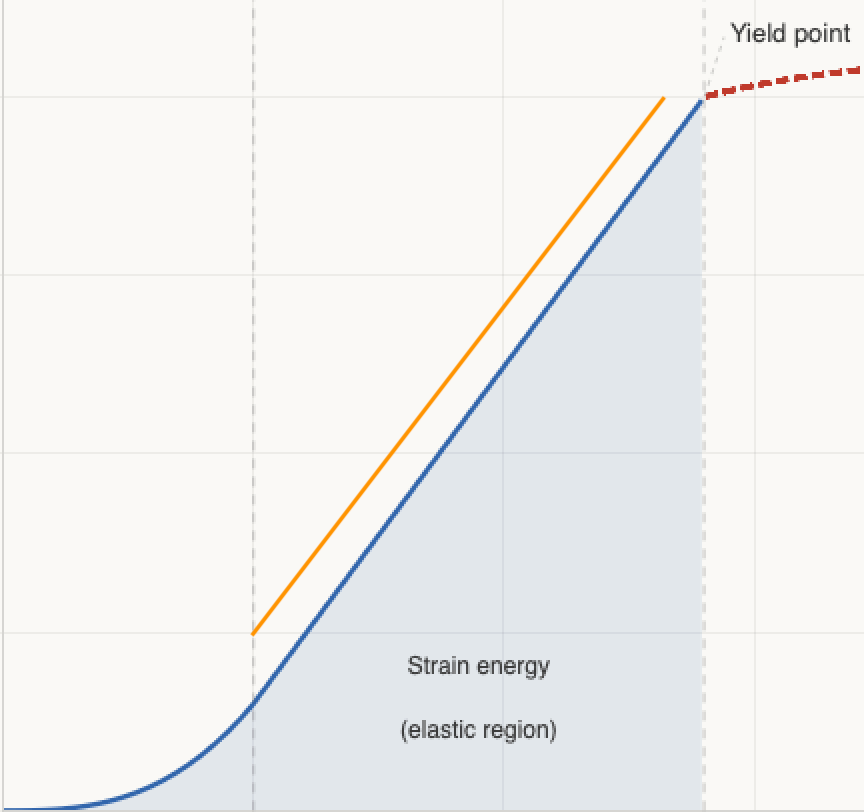
The first term is what’s known as the yield point. This indicates the moment when the load applied to the tissue has reached such a point that it starts to create a change in the shape of the tissue that won’t change back. This is the point in which loading creates tissue damage. Enough load pulled on tissue so that it will not return back to its original form. Think of this point as the “point of no return”. Pretty important when thinking and discussing these tissues from an injury perspective. Based on its importance, it’s going to serve as our “North Star” when looking to modify tendon behavior with training.
The next term is going to the Elastic Modulus, or Young’s Modulus. This is going to be the slope of the curve. If you remember back to high school algebra, slope = rise/run. In a simplified way, the Elastic Modulus = Strain/Stress. This is the objective way to measure the material properties of a tendon, and answers the question of how does this tissue behave under load. Stiffness is a combination of tendon geometry and the elastic modulus. Stiffness = Cross Sectional Area ((CSA) x Elastic Modulus)/Tendon Length. Since we can’t directly represent the length or width of the tendon in a stress strain curve, the slope of the curve becomes a proxy for the stiffness of the tendon. A steeper slope (stress>strain) means that a tendon would be stiffer, a shallower slope (stress<strain) means that a tendon would be more compliant. In practical terms, a stiffer tendon just means that it takes more stress (load/force) to stretch or deform a tendon a certain percentage of its length.
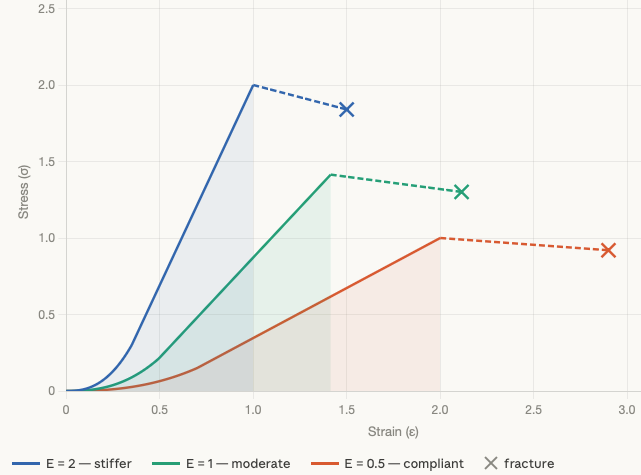
Lastingly, let’s define toughness. In order to quantify toughness of a tendon we need to measure the amount of surface area under the curve itself. This is a measure of strain energy, or how much energy the tendon can absorb prior to damage. A simplified equation for the amount of strain energy is Strain Energy = (Stress x Strain)/2. This value is a combination of our two major values, if a tendon that can stretch more, withstand more stress, or both, adds to its ability to absorb energy. A tissue that can absorb more energy without damage is tougher.
Now that we have all of our terms laid out, let’s have a conversation about the efficacy of the adaptations.
If we think about the purpose of tendons, they function to absorb and then return the maximum amount of energy when performing sporting activities. Which would mean that our goal when it comes to improving and training tendons for performance should focus on increasing the surface area under the curve, increasing strain energy, there by increasing toughness. When increasing toughness, the goal is to increase both the amount of stress AND the amount of strain that a tendon can tolerate. The optimal goal for tendon training would be to take the yield point, and move it both UP and RIGHT, away from the 0,0 mark on the graph. So not only would we be increasing the amount of energy the tendon can absorb, we can also view this as increasing the amount of stress AND strain a tendon can tolerate prior to damage.
Stiffness only is focused on increasing the amount of strain that a tendon can withstand. By making the slope steeper, we’re taking the yield point and moving it UP and LEFT, or potentially just LEFT. So yes there is potential for increasing the total energy strain absorbed, but any time the yield point moves left it means that a tendon can’t strain as much prior to damage. So a stiffer tendon will require more force to deform, but it has less ability to deform prior to damage. The other piece to consider is that stiffer tendons are potentially more metabolically taxing. Ground reaction forces alone aren’t what deforms tendons, it’s muscle activity. So if a tendon is harder to deform, requiring more force to absorb for energy, it’s requires more work from the musculature to create the deformation.
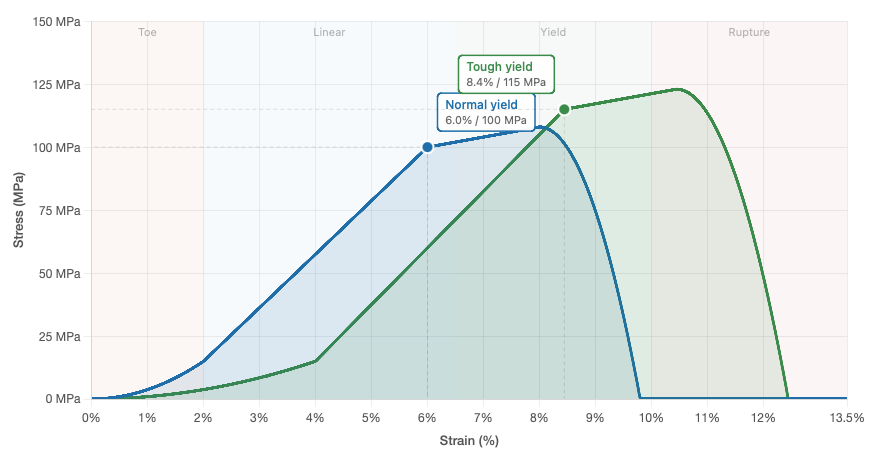
To recap, The goal of tendon training and rehab should be to increase the amount of strain energy a tendon can absorb, this increases a tendon’s toughness. This is represented visually by the surface area under the curve, and objectively by multiplying Stress x Strain.
Training stiffness will increase the strain portion of this equation, but it leaves half of the equation un-touched. Increasing the strain that a tendon can tolerate is the other half of the equation that is necessary for tendon training and rehab. In upcoming posts we’ll explore this in more depth.
-Campo